


Your shopping cart is empty!
Candelabra Primula (Japanese Primrose) mix
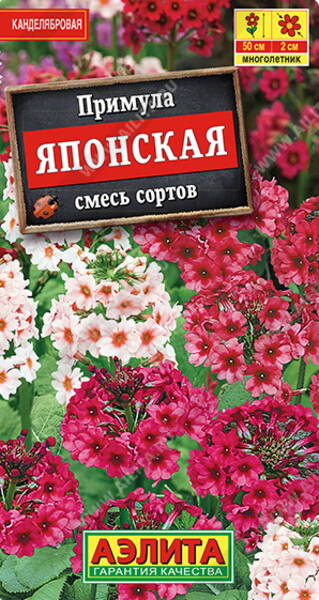
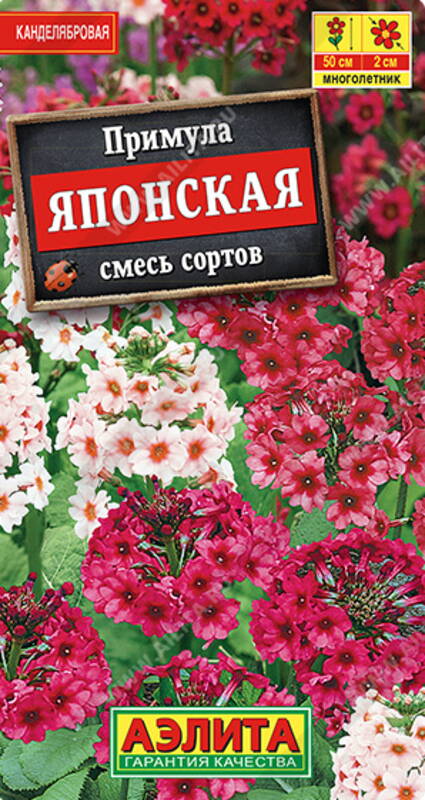
Japanese Primrose (mixed colors) — Primula japonica.
A very beautiful and popular candelabra primrose.
A perennial plant with a basal rosette of oblong-lanceolate, thick green leaves and flower stalks rising above it (40—50 cm high), carrying clouds of elegant, bright red-pink shades of flowers 2 cm in diameter. The flowers are arranged on the flower stalk in whorls (often forming up to five tiers).
It looks beautiful in flower beds and borders, which is especially important for the shady parts of the garden where it will feel very comfortable. Can be used for cutting.
Strong flower stalks about 40—50 cm high rise above the lush rosette of oblong leaves. Blooming is early, lasting about 40 days.
The plant is a perennial, ideal for a shade garden. Multi-tiered whorled inflorescences look especially attractive under the canopy of fruit trees or on the banks of a reservoir in combination with hostas, ferns, and astilbes. The mixture is suitable for cutting and winter forcing in pots.
A very beautiful and popular candelabra primrose.
A perennial plant with a basal rosette of oblong-lanceolate, thick green leaves and flower stalks rising above it (40—50 cm high), carrying clouds of elegant, bright red-pink shades of flowers 2 cm in diameter. The flowers are arranged on the flower stalk in whorls (often forming up to five tiers).
It looks beautiful in flower beds and borders, which is especially important for the shady parts of the garden where it will feel very comfortable. Can be used for cutting.
Strong flower stalks about 40—50 cm high rise above the lush rosette of oblong leaves. Blooming is early, lasting about 40 days.
The plant is a perennial, ideal for a shade garden. Multi-tiered whorled inflorescences look especially attractive under the canopy of fruit trees or on the banks of a reservoir in combination with hostas, ferns, and astilbes. The mixture is suitable for cutting and winter forcing in pots.
SOWING: in late April — May into the ground on nursery beds, slightly deepened into the soil, or in February — March for seedlings (to get a more reliable result, crops are first frozen for 3—4 weeks at a temperature not higher than −10 °C, after which they are placed on a window, shading from direct sun). Seedlings appear in 16—18 days. It is necessary to ensure that the soil does not dry out. After the appearance of the first true leaf, the plants are pricked out. Planted in open ground in May — June when the threat of frost has passed. Can grow in one place for up to 5 years.
Prefers semi-shady areas with loose, but sufficiently moistened soil, free from weeds.
Dormant autumn sowing in open ground at the end of October is possible.
CARE: for long and abundant blooming, the plants need timely watering, regular weeding, loosening, and fertilizing.
In the spring, primroses are very demanding of moisture but do not tolerate stagnant water. After flowering, the plant must be fed with a small dose of complete mineral fertilizer. As it grows, add nutritious soil to the roots. Winter-hardy under snow cover, but it is better to cover for the winter with dry tree leaves in a layer of 10—15 cm.
Biological features: primrose is a perennial herbaceous plant of the Primrose family (Primulaceae), found everywhere in the temperate zones of the Northern Hemisphere. This is an herbaceous plant with dense wrinkled leaves and large bell-shaped or funnel-shaped, fragrant flowers of various colors. In cultivation, these plants are used primarily for planting in borders or small groups.
Primrose is sown in the spring — in early summer. Seeds germinate for quite a long time; they need moisture for successful germination. Before sowing, the soil is watered, the seeds are evenly distributed on the soil surface and slightly moistened from a spray bottle. After that, the box is covered with glass or film and placed in a bright place at +15—20 °C. Seeds do not germinate simultaneously, over about 10—25 days. The soil surface must be regularly moistened from a spray bottle. When 1—2 true leaves appear, the seedlings are pricked out. Germinated seeds very often die due to the fact that their small roots are directed upwards. For them to root safely, the emerging seedlings must be sprinkled with a thin layer of earth and moistened. If you sowed seeds in the spring, by the end of summer you will get well-developed plants that can be transplanted to a permanent place in early September. The following spring, the first flowers will appear on them, but abundant flowering will occur only a year later.
Primroses bloom for quite a long time (from April to late June). Primrose prefers moistened soils with the addition of turf soil and organic fertilizers (compost, leaf earth, well-decomposed humus). On light sandy soils, 10 kg of compost earth per 1 m² is added for digging. On heavy clay soils, in addition to these organic fertilizers, 1—2 buckets of sand per 1 m² are added. The soil is cultivated to a depth of 12—17 cm.
Planting: primroses must be planted in such a way that the plantings are closed, and there is no open space between the rosettes of leaves. The planting distance for small species should be 10—15 cm, and for larger ones — 20—30 cm. For two years, the plants are grown, covering them for the winter with a 10 cm layer of foliage. Primroses are planted in a permanent place in the spring or autumn of the second year.
Plant care: you need to ensure that the soil is always moist and loose, regularly remove weeds. In spring, primroses are very demanding of moisture (but do not tolerate stagnant water). After flowering, it is recommended to water the plants with highly diluted liquid manure or feed them with a small dose of complete mineral fertilizer (20—30 g/m²). If primroses are not divided for a long time, they can freeze out. A year or two after planting, nutritious soil can be added to the roots in the autumn so that the growing rhizomes do not freeze. For the plants to endure the winter well, you need to try to keep the rosette of leaves until late autumn (it serves as a natural shelter). Such species as the drumstick primrose, common, and Japanese, are best covered for the winter with dry tree leaves in a layer of 10 cm.
Propagation.
Division of the bush is carried out in early spring or in August — early September. Plants can be divided immediately after flowering, in the 3rd—5th year of cultivation. The bushes are divided into small parts consisting of one leaf rosette with a rhizome. After planting, they are watered daily for 2 weeks. Some species (for example, auricula primrose — Primula auricula) are propagated by small leaf rosettes, which root well in cold frames or on beds, with mandatory shading. Here they overwinter, and in the spring they are planted in a permanent place. Drumstick primrose (Primula denticulata) can be propagated by root cuttings. In large specimens, several thick roots are separated; to accelerate the formation of buds in the upper part of the root, a longitudinal cut 1—1.5 cm long is made. Prepared cuttings are planted in light soil to a depth of 3 cm. In the future, they are cared for using conventional technology.